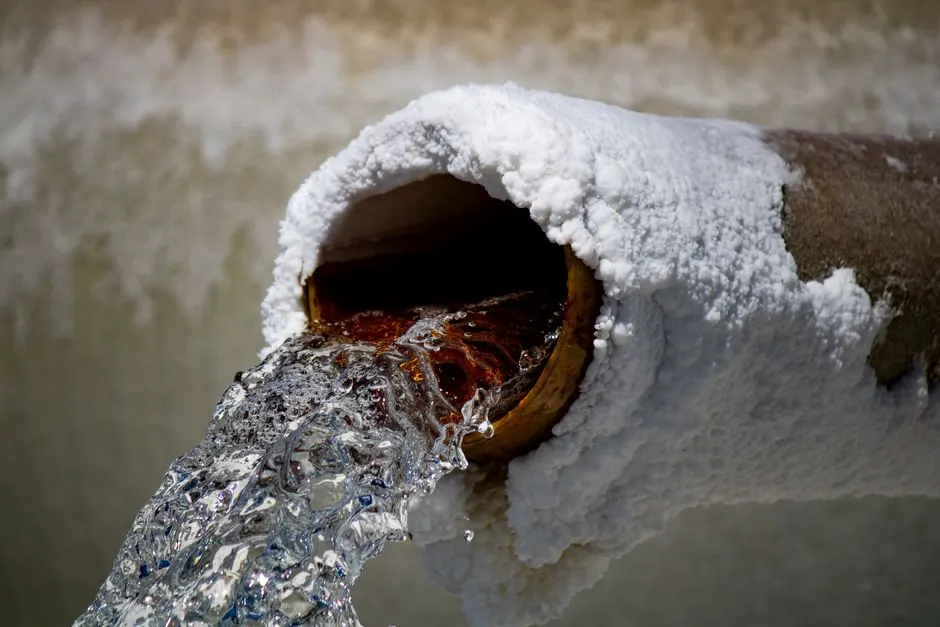
You protect your West Valley City home from winter pipe bursts by keeping the heat at 55°F or higher, insulating every pipe that runs through the attic, crawl space, or garage, and sealing the exterior gaps where cold air reaches your plumbing. Those three moves stop the vast majority of freeze events we see between November and March. The rest of this post covers the specific temperatures, materials, and thawing steps that matter in our valley, plus what to do when a pipe lets go anyway.
Why West Valley City pipes burst in winter
West Valley City pipes burst because water expands about 9% when it freezes, and that expansion cracks copper, PEX, and CPVC alike. A pipe does not have to split at the ice block itself - pressure between the ice and a closed faucet is often what tears the line. Our winters swing hard: a 45°F afternoon can drop to 12°F overnight, and that rapid change is what catches homeowners off guard.
Homes built in the 1950s through the 1980s across neighborhoods like Hunter and Granger were framed with plumbing in exterior walls and unheated attic runs. Those are the first lines to freeze. Newer builds in the western bench areas do better, but any pipe in a garage wall or crawl space is still exposed.
For context, how to protect your West Valley City home from winter pipe bursts UT is really a question about three things: heat, insulation, and airflow. Get those right and you remove the conditions that cause a burst.
What temperature should I keep my house to prevent frozen pipes in West Valley City UT?
Keep your thermostat at 55°F or higher at all times, even when you travel, and 68°F to 70°F while you are home during a hard freeze. The 55°F floor is the number that matters most - below it, pipes in exterior walls and crawl spaces start dropping toward 32°F within a few hours.
Two details we tell every customer:
- Open cabinet doors under kitchen and bathroom sinks on exterior walls. That lets room air reach the supply lines.
- Let one faucet drip - a pencil-lead stream - overnight when the forecast hits the teens. Moving water takes far longer to freeze than standing water.
If you leave for a week in January, do not shut the furnace off. Set it to 55°F and leave the cabinet doors open. We have walked into too many homes in February where a vacation thermostat setting of 50°F turned into a burst line and a soaked basement.
When a freeze does cause damage, our team handles Residential Water Damage Restoration West Valley City UT for exactly this scenario - frozen supply line, split pipe, water across the floor.
Pipe insulation and winterizing steps that actually work
Pipe insulation in West Valley City UT works best when you match the material to the location. Foam tube sleeves handle interior runs. Heat tape belongs on the lines most likely to freeze. Here is what we install and recommend:
- Foam tube sleeves (½-inch wall or thicker) on every accessible pipe in the attic, crawl space, basement, and garage. Cost runs about $1 to $3 per linear foot in 2026.
- Self-regulating heat tape on the two or three lines that have frozen before. It draws roughly 3 to 8 watts per foot and only runs when the pipe drops below about 40°F.
- Fiberglass or foil-faced wrap over heat tape to push warmth back into the pipe instead of the crawl space air.
- Pipe insulation on exterior hose bibs plus a hard cover. A $12 cover prevents a $400 repair.
Air sealing matters as much as insulation. Cold air pouring through a foundation vent or an unsealed rim joist will freeze a pipe no matter how well you wrapped it. We foam or block every gap we can reach during a winterization visit.
If you want the whole job done in one trip, we offer full Structural Drying Services West Valley City UT after a freeze event, but the smarter call is to winterize before the first hard freeze in late October or early November.
How do I thaw frozen pipes in West Valley City?
Thaw frozen pipes in West Valley City by shutting off the main water valve, opening the nearest faucet, and warming the pipe with a hair dryer, heat lamp, or wrapped towels soaked in hot water - never with an open flame. Start at the faucet end and work back toward the frozen section.
Steps in order:
- Shut off the main valve so a split pipe does not flood the house when it thaws.
- Open the affected faucet so melting water has somewhere to go.
- Apply gentle heat - hair dryer on low, heating pad, or hot towels. Keep it moving.
- Watch for the first trickle. That tells you the block is breaking up.
- Once flow returns, check the whole run for leaks before you turn the main back on.
Do not use a torch, and do not pour boiling water directly on a frozen line - thermal shock can crack it. If you cannot reach the frozen section, or if you see water where it should not be, stop and call us.
For a line that has already split, our Burst Pipe Water Damage Cleanup West Valley City UT crew extracts the water, dries the structure, and documents the damage for your insurance claim.
Common mistakes that lead to burst pipes
The most common mistake we see is a thermostat set too low during a trip or a cold snap. The second is skipping the crawl space and attic entirely because the pipes are hard to reach. Both cause the same result.
Watch for these:
- Setting the thermostat below 55°F while away. A 50°F setting feels safe and is not.
- Leaving the garage door open during a freeze. A pipe in the garage wall can freeze in a single night.
- Ignoring a dripping faucet. That drip is often the first sign of a partial freeze upstream.
- Insulating the pipe but not the vent. Cold air still wins.
- Thawing with a torch. We have seen two house fires from this in the last decade.
If you have already had one freeze this season, assume the same line will freeze again. Fix the cause, not just the symptom.
When to call a professional
Call a professional when you cannot reach the frozen section, when water is already pooling, or when the pipe has visibly split. Those are not DIY situations - a burst line can dump 4 to 8 gallons per minute into your home.
Our team at West Valley City Water Damage Pros handles the whole chain: locate the break, stop the water, extract it, and dry the structure. We work with your insurance adjuster and give you upfront pricing before we start.
If you are dealing with a commercial property, we also run Commercial Water Damage Restoration West Valley City UT for offices, retail, and warehouse spaces that freeze over a weekend.
Frequently Asked Questions
How do I protect my West Valley City home from winter pipe bursts?
Keep the thermostat at 55°F or higher, insulate every pipe in the attic, crawl space, and garage, seal exterior air gaps, and let one faucet drip overnight when temps hit the teens. Those four steps prevent most freeze events.
What temperature should I keep my house to prevent frozen pipes in West Valley City UT?
55°F is the minimum, even when you are away. While you are home during a hard freeze, 68°F to 70°F keeps exterior-wall pipes safely above freezing. Below 55°F, exposed lines can drop to 32°F within hours.
How do I thaw frozen pipes in West Valley City?
Shut off the main valve, open the faucet, and warm the pipe with a hair dryer, heating pad, or hot towels - never a torch. Work from the faucet toward the frozen section. If you cannot reach it, call us.
Who fixes burst pipes in winter in West Valley City?
West Valley City Water Damage Pros repairs burst pipes and cleans up the water damage. We handle extraction, structural drying, and insurance documentation. Call (385) 488-0549 for emergency service.
How much does pipe insulation cost in West Valley City UT?
Foam tube sleeves run about $1 to $3 per linear foot in 2026. A full winterization visit for a typical 1,800-square-foot home usually lands between $300 and $700 depending on attic and crawl space access.
Get help with Water Damage Restoration in West Valley City
If a pipe has already burst, every hour counts. We extract the water, dry the structure, and get your home back to normal.
Call West Valley City Water Damage Pros at (385) 488-0549 for emergency water damage restoration in West Valley City.